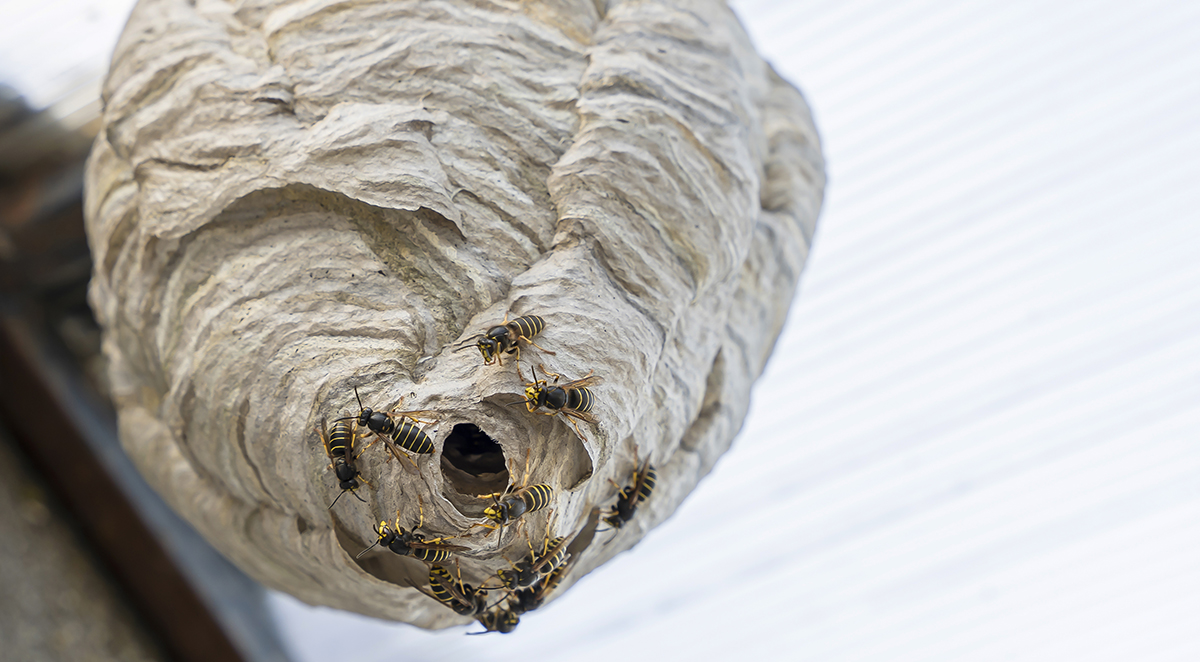
Suddenly discovering a papery gray nest tucked under an eave, or a stream of yellowjackets pouring out of a hole in the lawn can ruin a calm, late summer afternoon hanging out in the yard. By the time most homeowners notice a nest, the colony has been quietly building all season and has reached its largest and most defensive stage of the year.
Knowing how to get rid of wasp nest problems safely depends on correctly identifying the species, judging the location, and understanding when to do it yourself. This guide walks through what you can reasonably handle, what you should not touch, and when professional stinging insect control is the smart call.
Quick Summary
- Peak wasp season in Riverside County and North San Diego County runs through late summer and into fall, when colonies are at maximum size and aggression.
- Species identification drives everything: paper wasps, yellowjackets, and mud daubers behave very differently and require different approaches.
- Ground nests, wall void nests, high or hard to reach nests, and any nest near an allergic household member should be left to a professional.
- Common DIY mistakes, including spraying at midday or knocking down a nest with a pole, tend to trigger defensive swarming.
- Source Pest Control has served the region since 2011 and provides safe removal of stinging insect nests as part of our wasp and bee services.
Why Wasp Nests Become a Bigger Problem Late in the Season
Wasp colonies start small. A single overwintered queen builds a modest nest in spring, raises her first workers, and the population grows steadily through summer. By August and September, that same nest can hold a large workforce with a strong instinct to defend it.
Food pressure adds to the problem. As natural protein sources thin out, workers shift toward sugars, which is exactly why yellowjackets show up uninvited at picnic tables, trash cans, and soda cans in early fall. More foraging traffic near people means more accidental encounters, and more encounters mean more stings.
Wasps do provide real ecological value by preying on other insects, so removal is not always the automatic answer. The problem is proximity. Nests around your property create several genuine risks:
- Painful stings that can trigger severe allergic reactions in sensitive individuals
- Aggressive defense of nests, particularly by certain wasp species
- Anxiety and limited outdoor enjoyment when nests are near living spaces
- Multiple stings from social wasps defending their colonies
Identify What You Are Dealing With First
Before you consider any wasp removal effort, spend a few minutes observing from a safe distance. The nest shape and location tell you most of what you need to know.
Paper Wasps
Paper wasps build open, umbrella shaped nests with visible cells, typically under eaves, porch ceilings, and deck railings. You can usually see the individual hexagonal cells and a handful of wasps resting on the surface. These colonies become increasingly aggressive as they grow through the summer months, so a nest that seemed harmless in May often behaves very differently in August.
Yellowjackets
Yellowjackets are the species behind most emergency calls. They are highly aggressive when disturbed and build enclosed nests in the ground, inside wall voids, or in protected above ground locations. They are particularly problematic during late summer and fall when they are drawn to food at outdoor gatherings. Because the nest itself is usually hidden, homeowners often discover one by accident while mowing, gardening, or moving stored items, which is the worst possible way to find it. Yellow jacket removal is one situation where professional help is almost always warranted.
Mud Daubers
Mud daubers are solitary wasps that create distinctive tube-like mud nests on walls, eaves, and under decks. They are far less aggressive than social wasps and rarely defend their nests. Their nests can still damage and discolor surfaces, and old mud dauber nests sometimes get reused by other insects, so removal is often about appearance and maintenance rather than safety.
Is It Safe to Remove a Wasp Nest Yourself?
This is the question we hear most often, and the honest answer is that it depends entirely on the specifics. A small, newly built paper wasp nest in an open, reachable spot with no allergy concerns in the household is a reasonable DIY project for a cautious adult. Almost everything else is not.
Stop and call a wasp exterminator instead if any of the following apply:
- Anyone in your household has a known sting allergy or a history of severe reactions
- The nest is in the ground, inside a wall void, in an attic, or otherwise concealed
- The nest is high enough that you would need a ladder to reach it
- You have identified the insects as yellowjackets
- The nest is larger than a fist or shows heavy traffic in and out
- The nest sits near a doorway, walkway, play area, or pool where people pass frequently
- You cannot retreat quickly from the site, for example on a slope, a roof, or in a tight crawl space
The reason for that last point is simple. Social wasps do not sting once and stop. When a colony perceives a threat, workers respond in numbers and pursue, and there is no version of that scenario that ends well on a ladder. Read our blog on DIY vs. Hiring a Professional.
How to Safely Handle a Small, Accessible Nest
If you have weighed the risks above and the situation genuinely qualifies as low risk, follow a deliberate sequence rather than improvising.
- Confirm the species and watch the nest for several minutes to gauge activity level and locate every entry point.
- Clear the area completely. Move children, pets, patio furniture, and food well away, and let other household members know what you are doing.
- Wear full protective clothing: long sleeves, long pants tucked into socks, closed shoes, gloves, and eye protection.
- Wait until after dark or before dawn, when wasps are least active and nearly all workers are inside the nest.
- Skip the flashlight beam pointed directly at the nest, since light attracts wasps toward you. Use indirect lighting positioned to the side.
- Plan and clear your exit path before you begin so you can move away immediately without tripping over a hose or a planter.
- Follow all label directions exactly on any product you use, including required distances and personal protective equipment.
- Leave the area right away after treatment and do not return to check results until the following day.
- Remove the treated nest only once activity has fully stopped, then clean the site to discourage rebuilding.
If at any point the situation escalates, walk away calmly and steadily and let a professional finish the job. There is no benefit to standing your ground with a wasp colony.
Mistakes That Make Wasp Problems Worse
Many of the severe sting incidents we respond to trace back to a handful of avoidable errors:
- Spraying in the middle of the day, when foragers are out and return to defend the nest
- Knocking a nest down with a broom, rake, or pole, which scatters wasps without eliminating them
- Blocking the entrance to a wall void nest, which frequently drives wasps deeper into the structure and into living spaces
- Flooding a ground nest with water, which rarely reaches the full colony
- Using fire or fuel near a structure, an obvious hazard in our dry inland climate
- Treating only the visible nest when multiple nests exist on the property
When to Call a Professional for Stinging Insect Control
Professional treatment is not just about stronger products. It is about correct identification, safe access, and addressing the nests you have not found yet. Our approach to wasp and bee work follows three stages.
Thorough inspection. We begin with a comprehensive evaluation that includes identifying the specific species present, locating all nests on your property, assessing potential entry points into structures, determining the extent of the problem, and evaluating the risk to your family and property.
Customized treatment plan. Based on those findings, we develop a targeted strategy: safe and effective removal of accessible nests, treatment of nests in difficult locations such as wall voids and high eaves, protective treatments for likely nesting sites, and a focus on minimal environmental impact.
Preventative measures. For long term protection, we recommend sealing entry points that give access to wall voids and attics, suggest ways to reduce attractants, treat previous nest sites to discourage reestablishment, and offer guidance on landscape management that limits nesting opportunities.
Source Pest Control offers this stinging insect care as part of its wasp and bee management services.
Read our guide, “Is it worth it hiring a pest control company?”.
How to Keep Wasps From Nesting Next Year
Prevention is far less stressful than removal. Build these habits into your seasonal property maintenance:
- Inspect eaves, overhangs, soffits, sheds, playsets, and grill covers every few weeks in spring, when nests are still tiny
- Seal gaps, cracks, and utility penetrations that allow access to wall voids and attic spaces
- Keep outdoor trash and recycling containers tightly covered and rinsed
- Clear fallen fruit and cover food and drinks during outdoor gatherings
- Repair torn window screens and vent covers
- Watch for wasp interest around irrigation leaks and standing water
Many homeowners handle these steps as part of a broader pest plan. Our residential pest control programs include quarterly treatments, and every residential plan comes with free service calls between scheduled visits if activity returns.
Frequently Asked Questions
Is it safe to remove a wasp nest yourself?
Sometimes, but the exceptions matter more than the rule. A small paper wasp nest in an open, reachable location can be a reasonable DIY task for a protected, cautious adult with a clear exit path. Ground nests, wall void nests, elevated nests, yellowjacket colonies, and any situation involving a sting allergy call for professional handling.
What is the best time of day for wasp nest removal?
After dark or just before dawn, when temperatures are cooler and nearly all workers are inside the nest. Midday treatment leaves foragers out in the field, and they return to a disturbed colony ready to defend it.
Will wasps come back to the same spot?
They often will, because a location that offered good shelter once tends to remain attractive. That is why we treat previous nest sites and recommend sealing entry points rather than simply removing the nest and walking away.
How do I choose a company when I search for wasp nest removal near me?
Look for local licensing, regional experience, and a company that inspects before it treats. All Source Pest Control technicians are licensed professionals certified by the California Structural Pest Control Board, and we have served Riverside County and North San Diego County since 2011.
Are wasp treatments safe around children and pets?
We use products applied according to label instructions and will provide any necessary precautions for your specific treatment, such as keeping people and pets off treated areas until dry. If you have particular concerns, tell your technician during the inspection so we can plan around them.
Do you handle nests inside walls and attics?
Yes. Nests in wall voids and high eaves are among the most common calls we receive, and our treatment plans specifically address nests in difficult locations. Sealing those access points afterward is what prevents a repeat.
Enjoy Your Yard Again
If you have found a nest on your property in Temecula, Murrieta, Menifee, Fallbrook, Lake Elsinore, Wildomar, Winchester, or a surrounding community, our team can inspect the site and recommend the right approach. Source Pest Control has been locally owned since 2011, holds a 4.9 out of 5 star rating from more than 700 Google reviews, and was named a 2023 Neighborhood FAVES winner on Nextdoor. Learn more about our team or explore our wasp and stinging insect services, then reach out through our contact page or call (951) 401-1318 to schedule a free inspection and estimate.